


A Tree Worth Getting to Know
Rowan, Sorbus aucuparia, is one of those trees that rewards a second glance. It grows on moorland edges, in churchyards, along old field boundaries and in gardens up and down the country, and although it is often called mountain ash, it is no relation to the ash at all. Learning to recognise it is one of the most useful skills a woodland walker can acquire, because once you can spot rowan you will start seeing it everywhere — and noticing it in every season, from the ferny leaves of June to the scarlet berries that light up a grey November hedge.
Bark and Buds: Winter Identification
On a young or middle-aged rowan, the bark is smooth and silvery grey, sometimes with a faint purplish bloom on the sunlit side. Run your hand along it and it feels thin and cool, almost like polished slate. Look closely and you will see scattered horizontal lenticels, small greyish lines rather than the deep cracks of oak or the flaking plates of cherry.
Older trees change character. Once a rowan passes fifty or sixty years it develops shallow fissures and loose, scaly plates, darkened to a sooty grey. Even then, the twigs give it away: they are slender, slightly downy when young, and carry alternate buds — purple-brown, pointed, and dusted with fine grey hairs. A single terminal bud sits at the tip of each shoot, which helps separate rowan from ash, whose buds are black and sit in opposite pairs. On an exposed hillside, rowan often leans and twists, or grows as a multi-stemmed shrub rather than a tidy tree.
Leaves: The Feathery Giveaway
From late spring onwards, the leaves are the easiest clue. Rowan leaves are pinnate — divided into leaflets arranged along a central stalk — and typically measure 15–25cm long. Count them: you should find five to eight pairs of leaflets, plus one single leaflet at the very end.
Each leaflet is narrow and oblong, dark green above, paler and slightly blue-green beneath, with sharply serrated edges that are toothed almost all the way to the base. This is the detail worth memorising. Ash leaflets are broader, more oval, and their teeth are coarser and more irregular, clustered towards the tip. Rowan leaves are also arranged alternately along the twig, while ash leaves sit in opposite pairs. Hold a leaf up to the light and the rowan's neat, saw-edged symmetry is unmistakable.
In autumn the whole crown turns butter yellow, copper and sometimes a deep wine red, often while the berries are still hanging — a combination that makes rowan one of the finest small trees for seasonal colour.
Flowers, Berries and the Turning Year
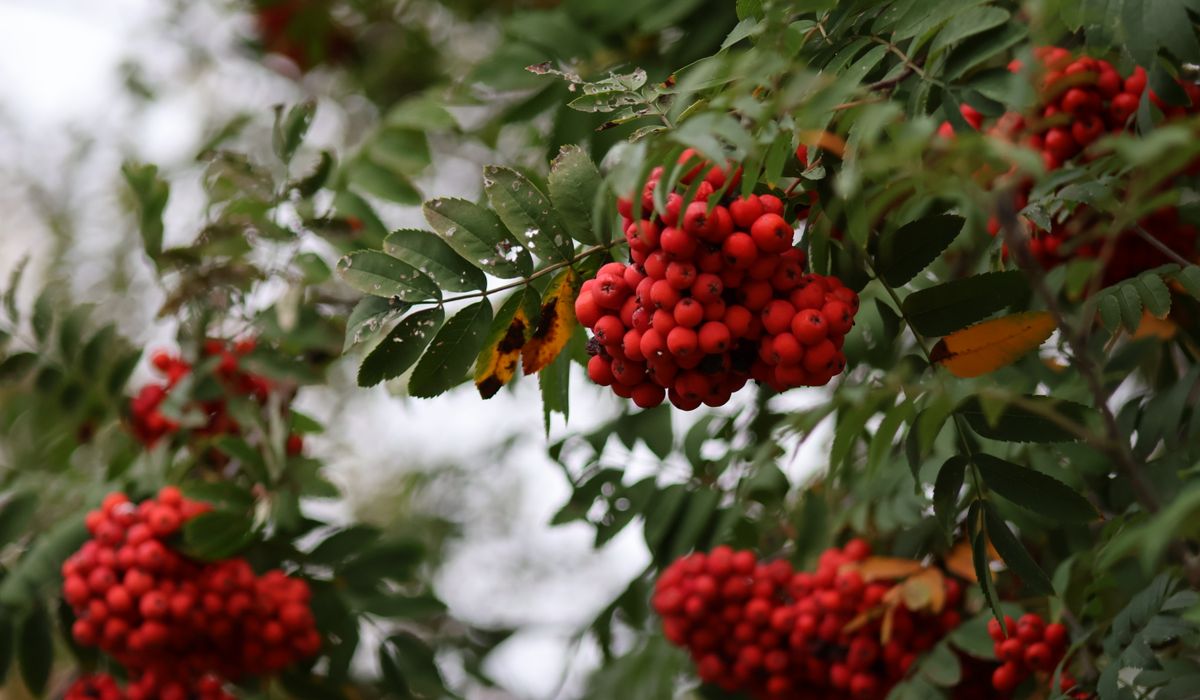
Rowan flowers in May and early June, covering the tree in flat-topped clusters of creamy white blossom. The scent is sweet but faintly musty, and bees adore it. By late August the clusters have transformed into heavy sprays of berries, ripening from green through orange to a brilliant scarlet by September.
The berries are small, round, and borne in dense bunches rather than scattered singly. They are edible in the sense that they are not poisonous, but raw they are mouth-puckeringly bitter and best left alone — cooking them for rowan jelly, to serve with game or venison, is the traditional British use.
Watch how long they last. In a poor berry year the thrushes strip a tree in a fortnight; in a heavy year, fruit can hang into January, and a really good crop may draw in redwings, fieldfares and, in exceptional winters, a flock of waxwings from Scandinavia.
Rowan or Something Else? Quick Comparisons
- Ash — opposite leaves and buds, black velvety buds, no red berries, taller and more upright.
- Elder — pinnate leaves but with a rank smell when crushed, black berries, soft pithy stems.
- Whitebeam and service tree — simple, undivided leaves with white-downy undersides, not feathery.
- Wild cherry — smooth grey bark with prominent horizontal bands, but simple oval leaves and cherries, not berries.
Growing and Watching Rowan
Rowan is one of the most generous trees you can plant in a British garden. It tolerates poor, thin, acid soil, exposed sites and cold, and it stays small enough — usually 8–15 metres, often less — for a modest plot. Bare-root plants go in between November and March, and they establish quickly with little fuss.
Plant one for the wildlife as much as for yourself: the spring blossom for pollinators, the leaves for moth caterpillars, and the autumn berries for hungry winter birds. Leave most of the crop for them and take only what you need for a few jars of jelly. Then, through the year, keep a note of when it flowers, when the leaves turn, and how heavy the berry crop is. Rowan trees in the same district often fruit in unison, so once you have learned one, you have learned the season.


Leave a reply